Expat Taxes 101: How Living Abroad Cuts Your US Tax Bill
the Foreign Earned Income Exclusion, explained end-to-end
First, why should you listen to me?
- Software engineer based in Hong Kong (with a sprinkle of digital nomad), with the full company lifecycle behind me: startup, fundraising, IPO.
- Tech-comp tax situation: ISOs, RSUs, AMT credits.
- 3 years self-filing US returns and manually reading through IRS forms, with a Senior CPA validating my work.
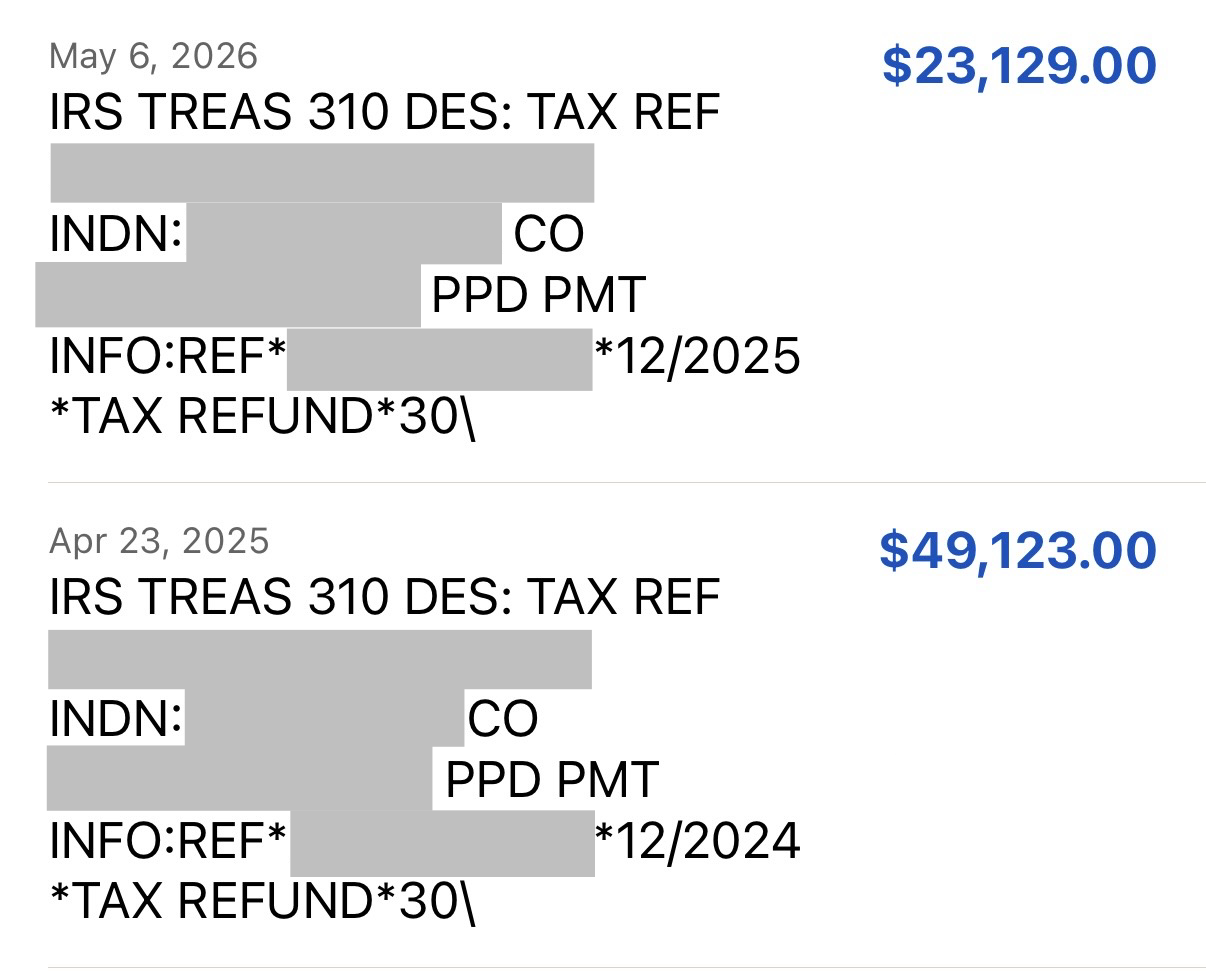
The past 2 years, I've used the FEIE (plus a few other hacks I'll write up later) to cut tens of thousands of dollars off my federal tax bill, completely legally.
What is FEIE?
The Foreign Earned Income Exclusion lets US citizens and residents working abroad exclude up to $130,000 of foreign-earned wages from federal taxable income in 2025. To qualify, your tax home has to be in a foreign country, and you have to pass one of two tests:
- Physical Presence Test (the one I use): at least 330 full days in a foreign country or countries during any 12-month period. Purely objective: count the days, plan travel around them.
- Bona Fide Residence Test: a facts-and-circumstances alternative for people clearly settled abroad for a full calendar year. If you can count to 330, you usually don't need it.
How the exclusion flows through federal and state tax forms has real consequences on how much you save. That's the focus of this post.
Part 1: Federal Taxes
This is where the bulk of savings happens. The interactive chart below shows how FEIE affects federal tax across an income range from $0 to $500K.
The grey line is what you'd pay without FEIE (i.e., if you didn't live abroad), the green line is what you pay with it, and the shaded region between them is what you save.
How the exclusion actually works
IRS Form 2555 is ultimately the source of truth for how this exclusion works. Boiled down, the math is:
where is the standard deduction and accounts for the cases where your income is lower than the exclusion limit.
The implication of subtracting is that the exclusion eats the lowest brackets, not the highest. It wasn't always this way. Before TIPRA took effect in 2006, excluded income simply disappeared and your remaining dollars started over at 10%. The current "stacking rule" taxes what's left as if the excluded $130K were still sitting underneath it.
Here are the 2025 federal brackets for a single filer:
| Marginal rate | Bracket (Single) | Inside FEIE? |
|---|---|---|
| 10% | $0 – $11,925 | yes |
| 12% | $11,925 – $48,475 | yes |
| 22% | $48,475 – $103,350 | yes |
| 24% | $103,350 – $197,300 | partial (up to $130K) |
| 32% | $197,300 – $250,525 | — |
| 35% | $250,525 – $626,350 | — |
| 37% | $626,350+ | — |
For a single filer taking the entire exclusion of $130K, that sums to about $24,047 ($18,428 for a single-earner MFJ; two qualifying earners each get their own exclusion). That's the hard cap, and it's why the shaded region in the chart goes essentially flat once your income clears the limit. Every dollar above gets taxed at the same marginal rate it would have been without FEIE.
Part 2: State Taxes (the Sunshine Tax is so real)
The other (and more complicated) half of the story.
Most state returns start their calculation from the Federal Adjusted Gross Income (AGI), which is computed after FEIE flows through Schedule 1 of Form 1040. These states inherit the exclusion automatically.
California is the conspicuous exception. Below are four cherry-picked locales: three that play nicely with FEIE, and one that very much does not. Each panel plots state + city tax so the geographic difference is visible:
Seattle, Washington
Northern Virginia
New York City
San Francisco Bay Area, CA
- State Tax (No Deduction)
- $0
- State Tax (With Deduction)
- $0
- Savings Due to FEIE
- $0
- State Tax (No Deduction)
- $13,629
- State Tax (With Deduction)
- $6,154
- Savings Due to FEIE
- $7,475
- State + City Tax (No Deduction)
- $23,433
- State + City Tax (With Deduction)
- $10,368
- Savings Due to FEIE
- $13,065
- State Tax (No Deduction)
- $19,158
- State Tax (With Deduction)
- $19,158
- Savings Due to FEIE
- $0
- Seattle, Washington is the base case. No state income tax to begin with, so nothing to save, nothing to lose.
- Northern Virginia has a relatively low top state tax rate of 5.75% and explicitly follows Federal AGI (Va. Code §58.1-322). Expect modest savings at a high income.
- New York City has a high state income tax with an additional city-resident tax stacked on top. Both honor the federal exclusion. NYC's reputation for heavy taxation made me expect the opposite; nice to be wrong. Expect high savings at a high income.
- San Francisco Bay Area, CA has a high state tax and explicitly does not honor FEIE. No tax savings here for as long as California counts you as a resident, even if you spend zero days in the state. As a California resident for 7 years, this tracks 😂.
One framing note: all four panels model someone who keeps their current state residency while abroad, the honest starting point when you're new to this and haven't decided whether the move is permanent. Once you know you're staying, there's a bigger lever than conformance: severing your state residency entirely. That's its own playbook (safe harbors, sticky states, the South Dakota trick) and gets its own post, Expat Taxes 103.
Putting it all together: $250,000 / Single / 2025
| Locale | Federal Savings | State + City Savings | Total Savings |
|---|---|---|---|
| Seattle, Washington | $24,047 | $0 | $24,047 |
| Northern Virginia | $24,047 | $7,475 | $31,522 |
| New York City | $24,047 | $13,065 | $37,112 |
| San Francisco Bay Area, CA | $24,047 | $0 | $24,047 |
Seattle and the SF Bay Area always show the same total: California's non-conformance erases the state portion entirely, leaving you with exactly the federal stacking-rule savings and nothing more.
Caveats
The model assumes all income is foreign-earned W-2 wages, the standard deduction, and a full year of qualification (in your first and last year abroad, the $130K cap is prorated by qualifying days). MFJ is modeled as a single earner; when both spouses qualify and earn, each gets their own exclusion, up to $260K combined. New York's tax-rate recapture (which phases out the lower brackets above ~$107,650 of AGI) is also omitted; it understates NY tax slightly at high incomes without changing the shape.
Beyond that, the model deliberately ignores several mechanics that can change a real return:
- Foreign Tax Credit (FTC). When you pay significant foreign income tax, the FTC can be a better option than FEIE. We don't model it because in our situation FEIE produces a larger US tax saving than FTC would. If you're an expat in a high-tax jurisdiction, run both numbers.
- Foreign Housing Exclusion. Stacks on top of FEIE and relevant in high-rent locales.
- Alternative Minimum Tax (AMT). A parallel tax system that recalculates your liability with fewer deductions. (More on this in Expat Taxes 201.)
- Payroll taxes. FEIE excludes income tax only. Contractors keep paying the 15.3% self-employment tax, and W-2 employees of US employers keep paying their 7.65% FICA.
- The election is sticky. Revoke FEIE (say, to switch to the FTC) and you can't claim it again for 5 years without IRS consent.
- Credits you give up. Claiming FEIE disallows the Earned Income Credit and the additional child tax credit.
The point isn't a precise return. It's the shape of the savings. Once you see it, the difference between "we live in San Francisco abroad" and "we live in New York abroad" stops being a rounding error.